
Written by
El Amine
January 22, 2026
6 min read
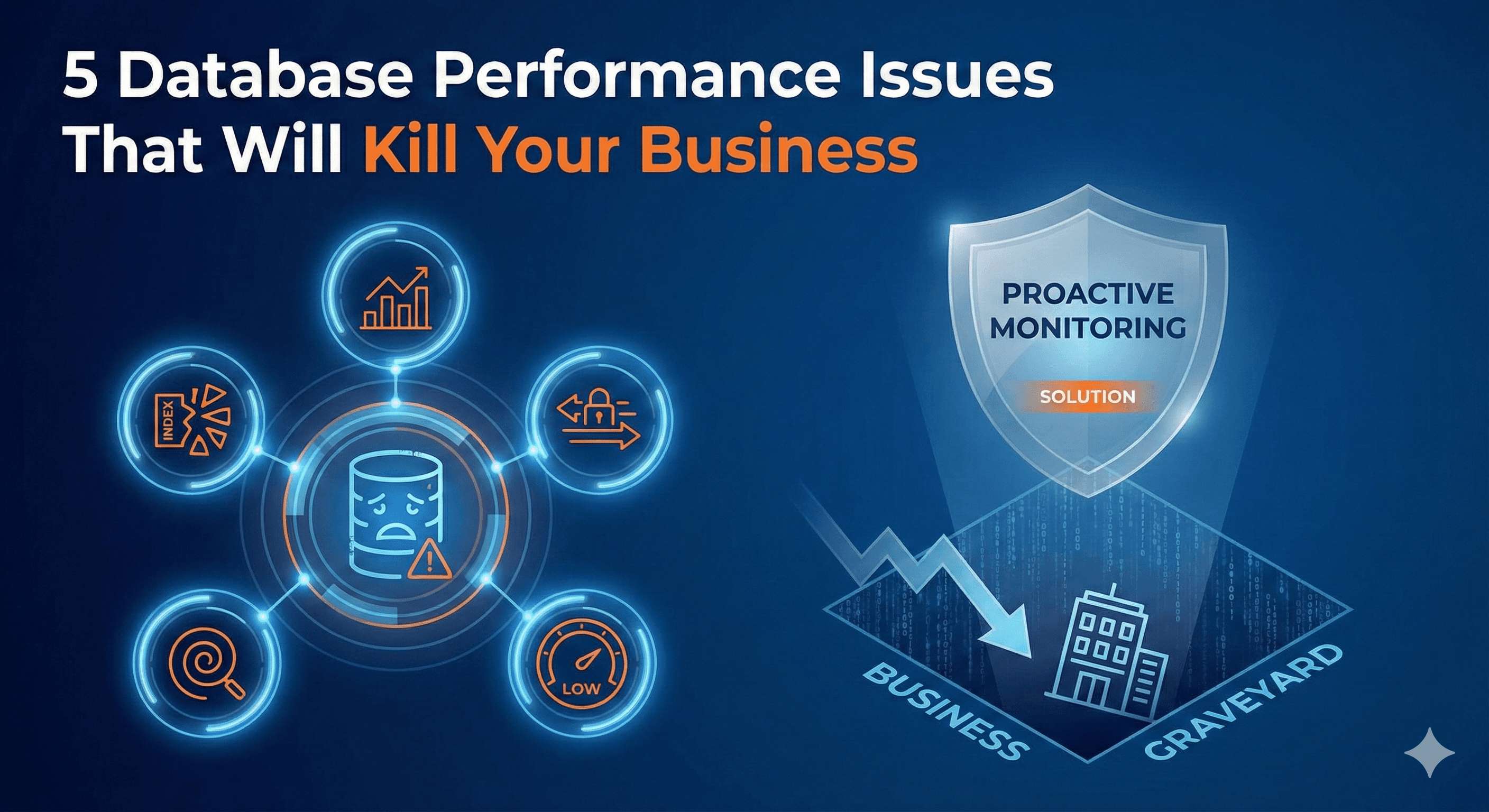
Database performance problems don't announce themselves with dramatic failures. They creep in quietly, slowly degrading your application until customers start abandoning carts, support tickets pile up, and revenue trends downward. By the time you notice the symptoms, you're already bleeding money.
Here are the five silent killers that destroy database performance—and how to stop them:
1. Index Fragmentation
Your database indexes are like the table of contents in a book. When they become fragmented over time, the database has to work exponentially harder to find the data it needs. This manifests as gradually slowing queries that nobody notices until page load times cross from "acceptable" to "unacceptable."
The insidious part? Index fragmentation happens naturally with every insert, update, and delete operation. It's not a matter of if it will happen, but when. Without regular index maintenance, even well-designed databases slow to a crawl.
The Business Impact: A query that took 100ms yesterday now takes 2 seconds. Multiply that across thousands of queries per minute, and you've got an application that feels sluggish to users. Studies show that a 1-second delay in page load time can reduce conversions by 7%. For a business doing $100,000 per day in revenue, that's $7,000 lost—every single day.
2. Missing Statistics
SQL Server and other databases use statistics to make intelligent decisions about how to execute queries. When these statistics are outdated or missing, the query optimizer makes bad choices—like scanning entire tables instead of using indexes, or choosing inefficient join strategies.
This problem is particularly dangerous because it doesn't affect all queries equally. Some queries run fine while others inexplicably take minutes to complete. Teams waste weeks troubleshooting application code when the real culprit is stale database statistics.
The Business Impact: Inconsistent application performance creates a terrible user experience. Some customers get fast responses while others time out. This randomness is worse than consistent slow performance because it's unpredictable and harder to diagnose.
3. Unmonitored Blocking and Deadlocks
When database transactions lock resources and wait for each other, you get blocking. When two transactions wait for resources the other holds, you get deadlocks. Both kill application performance and create bizarre user-facing errors that seem impossible to reproduce.
The worst part? These issues often happen during peak load, making them hard to troubleshoot. By the time your team investigates, the blocking has cleared and the deadlock has resolved, leaving no trace except confused users and failed transactions.
The Business Impact: Blocked transactions mean users sitting on loading screens. Deadlocks mean failed checkouts and lost orders. For an e-commerce site, every deadlocked transaction is a customer who might not come back.
4. Runaway Queries
A single poorly written query can consume all available database resources, bringing down your entire application. This often happens when developers deploy code changes without testing at production scale, or when report queries accidentally scan millions of rows instead of thousands.
These queries are especially dangerous in shared database environments where one application can starve all others of resources. You might not even control the code causing the problem, but you suffer the consequences.
The Business Impact: When a runaway query consumes all CPU or memory, every application sharing that database grinds to a halt. This turns a localized code problem into a company-wide outage.
5. Invisible Capacity Constraints
Database growth is sneaky. Storage fills up gradually, memory pressure increases slowly, and suddenly you hit a cliff where performance falls off dramatically. By the time you're getting disk space alerts, you're already in crisis mode.
The same thing happens with connection pooling, tempdb space, and other shared resources. Everything works fine until you hit capacity, then everything breaks at once.
The Business Impact: Capacity problems often strike during your busiest moments—holiday shopping, end-of-month processing, or viral marketing campaigns. Exactly when you need your systems to scale up, they fall over.
The Solution: Proactive Monitoring
All five of these problems share a common characteristic: they're completely preventable with proper monitoring. The right database monitoring solution:
Tracks index fragmentation and alerts you before performance degrades
Monitors statistics freshness and ensures the query optimizer has accurate data
Identifies blocking and deadlocks in real-time, allowing immediate resolution
Catches runaway queries before they consume all resources
Forecasts capacity needs based on growth trends, preventing surprise outages
The difference between reactive and proactive database management is the difference between constant firefighting and smooth operations. You can either wait for users to report problems, or you can catch them before anyone notices.
Smart businesses choose prevention.